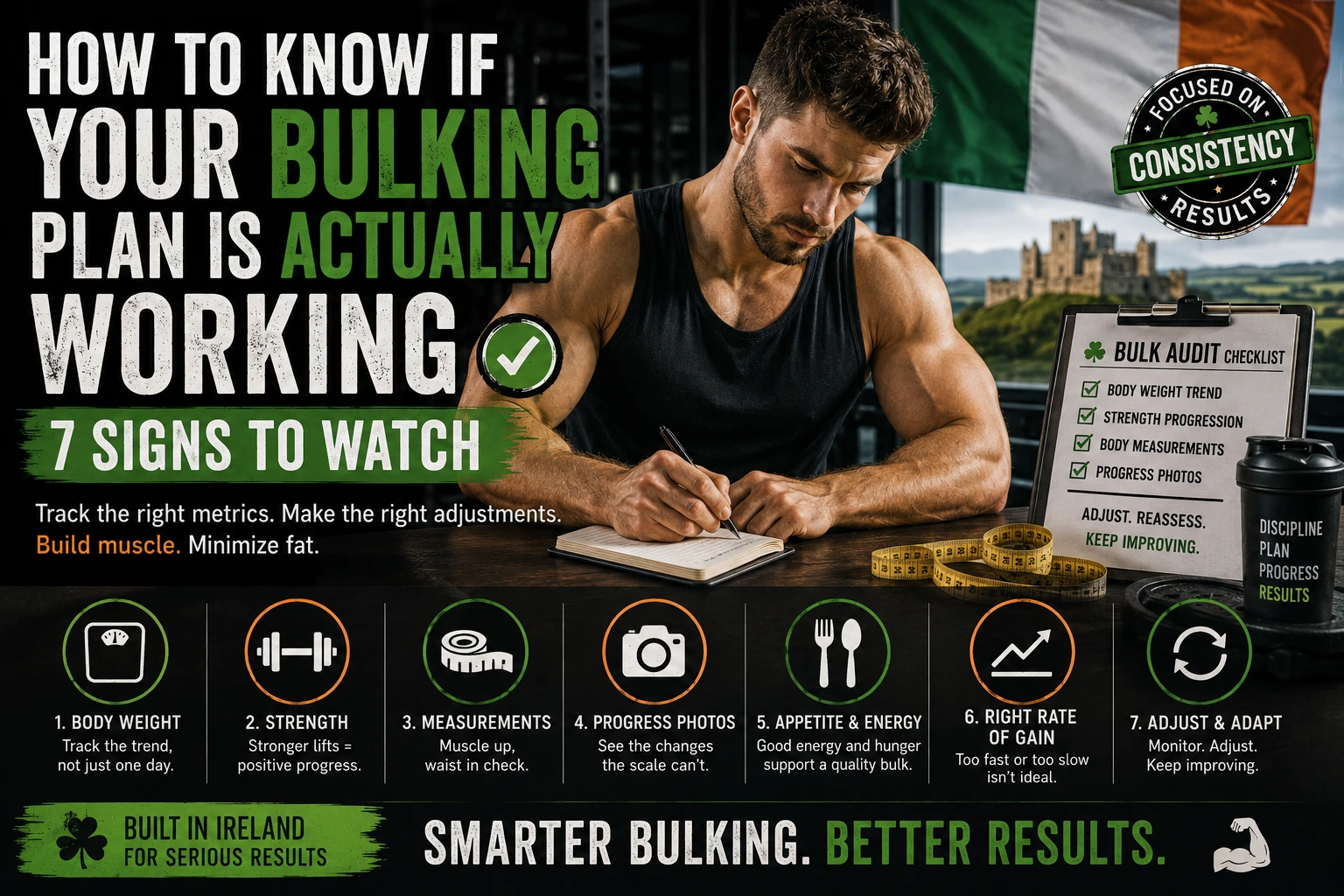
How to Know If Your Bulking Plan Is Actually Working
A successful bulk is not simply a period when the number on the scale goes up. If your goal is to build muscle, the more useful question is whether your body weight, training performance, measurements and overall physique are moving in the direction you intended.
Body weight can change because of water, glycogen, food volume, body fat and muscle tissue. A bulking phase therefore needs to be evaluated using several signals rather than a single weigh-in.
There is also no universally validated “perfect” calorie surplus that guarantees the ideal ratio of muscle gain to fat gain. Research identifies important gaps in the evidence around the precise energy surplus required for maximizing hypertrophy, with individual factors such as training experience, nutritional status and energy needs influencing the outcome.
This guide shows how to audit a bulking phase using practical markers, how to recognize when weight gain may be too fast or too slow, and what to adjust before making major changes.
What Does a Successful Bulk Actually Look Like?
A productive bulk should be judged by the direction of several measures over time, not by how quickly body weight increases.
- Body-weight trend — Is your average weight moving in the direction of your goal?
- Training performance — Are you maintaining or improving resistance-training performance?
- Body measurements — Are measurements changing in a way that fits your goal?
- Progress photographs — Does your physique look different under consistent conditions?
No single metric tells the whole story. The strength of a bulking assessment comes from looking at the signals together.
1. Your Average Body Weight Is Moving in the Right Direction
Track Weekly Averages
Record your weight consistently and look at the trend or average over time instead of reacting to a single morning weigh-in.
Ignore Sudden Day-to-Day Changes
Water balance, glycogen, sodium intake, digestive contents and hydration can all influence scale weight. A sudden increase or decrease does not automatically represent a change in muscle tissue.
A Faster Rate of Gain Is Not Automatically Better
The available evidence does not establish one universal energy-surplus “sweet spot” for every resistance-trained person. A review of the literature found that commonly repeated surplus calculations have not been validated well enough to identify a single optimal rate for maximizing muscle gain relative to fat gain.
Your rate of change should therefore be monitored and adjusted rather than forced toward a universal target.
2. Your Gym Performance Is Improving
More Reps With the Same Weight
Performing more quality repetitions with a familiar load while maintaining similar technique can be a useful sign of progression.
More Weight With Similar Technique
Increasing load while keeping execution reasonably consistent is another useful performance marker. Heavier loads that substantially change technique are less informative.
Better Training Performance Over Time
Look at trends across several sessions rather than expecting a personal record every workout.
Current evidence supports progressive resistance training as an effective stimulus for improving muscle size and strength. The 2026 American College of Sports Medicine position stand synthesized 137 systematic reviews involving more than 30,000 participants and concluded that progressive resistance training improves muscle strength and hypertrophy in healthy adults.
3. Your Measurements Are Changing
Measurements can provide information that the scale cannot. Useful measurements may include upper arms, chest, thighs and waist.
Why Waist Measurement Matters
If body weight is rising rapidly while waist circumference is also increasing quickly and training performance is not improving, that combination is worth investigating. It does not prove that every kilogram gained is fat, but it provides more context than scale weight alone.
Measure Under Consistent Conditions
Measure at a similar time of day and under similar conditions where practical. Use the same location and method each time.
4. Your Progress Photos Tell a Different Story
Photographs can reveal gradual physique changes that are difficult to notice when you see yourself every day.
- Use similar lighting.
- Keep camera distance consistent.
- Use similar poses.
- Wear similar clothing.
- Compare over meaningful periods rather than individual images.
5. Your Appetite and Energy Levels Are Telling You Something
How sustainable your diet feels can provide useful feedback. A plan that leaves you consistently uncomfortable, excessively full or unable to train well may need to be reconsidered.
Is Eating Enough Manageable?
Some people struggle to increase food intake because appetite becomes limiting, while others find it easy to exceed their target. Food selection, meal size, timing and energy density can affect how manageable a diet feels.
Is Your Training Energy Adequate?
If your diet leaves you consistently under-fuelled for training, performance may suffer. Conversely, eating substantially more than necessary does not guarantee better results.
Is Your Diet Sustainable?
A plan that works for two weeks but becomes impossible to maintain is not a particularly useful long-term strategy. Successful bulking is partly about finding an intake pattern you can follow consistently while monitoring results.
6. You Are Gaining Weight Too Quickly
Rapid weight gain deserves attention because additional body weight is not synonymous with additional muscle tissue.
If your weight is rising quickly but strength is not improving, waist is increasing rapidly, your physique is becoming noticeably softer, or training quality is not improving, reassess the current calorie intake and programme.
This does not mean rapid weight gain automatically equals excessive fat gain. It means that several indicators pointing in the same direction provide a reason to investigate.
Evidence on intentional weight gain in athletes is limited. A critical review notes that commonly recommended strategies often suggest a calorie surplus and a particular weekly rate of weight gain, but also concludes that evidence supporting a universal ideal rate is lacking.
7. You Are Not Gaining Weight at All
If your average weight remains essentially flat for a sustained period while your goal is to gain body mass, your current energy intake may not be producing the intended energy balance.
Before changing anything, check your actual food intake, average body weight, training performance, activity outside the gym and consistency with the planned diet.
If the trend remains unchanged after those factors have been assessed, a modest adjustment may be more sensible than a dramatic calorie increase.
The 4-Point Bulk Audit
| Metric | What to Watch | What It Tells You |
|---|---|---|
| Body Weight | Long-term trend | Whether total body mass is changing |
| Strength | Performance over repeated sessions | Whether training performance is progressing |
| Measurements | Muscle and waist measurements | Where physical changes may be occurring |
| Photos | Consistent visual comparisons | How your physique is changing over time |
Green: Multiple Signals Are Moving Together
Weight is trending upward, training performance is improving and measurements or photographs suggest positive physique changes. This is generally a reason to continue monitoring rather than making unnecessary changes.
Yellow: Weight Is Increasing but Other Signals Are Unclear
If the scale is moving but performance and physique changes are difficult to interpret, gather more data before making a major adjustment.
Red: Weight Is Rising Quickly Without Corresponding Progress
If weight and waist are increasing rapidly while performance is stagnant or declining, your current approach deserves a closer review.
What If Your Bulk Is Not Working?
Weight Is Flat and Performance Is Flat
Review calorie intake, protein intake, training progression and recovery.
Weight Is Increasing and Performance Is Improving
Continue monitoring. There may be no reason to make an immediate change simply because the scale is moving.
Weight Is Increasing Rapidly and Waist Is Increasing Rapidly
Review the size and consistency of your calorie surplus instead of assuming that more food will automatically produce more muscle.
Weight Is Increasing but Performance Is Declining
Look beyond calories. Training fatigue, sleep, exercise selection, recovery and overall programme structure may be contributing.
Weight Is Flat but Performance Is Improving
Do not automatically conclude that the bulk has failed. Strength improvements can occur without a large change in body weight.
How Often Should You Evaluate Your Bulk?
Evaluating a bulk every day can encourage unnecessary reactions to normal fluctuations. Collect information consistently and evaluate the trend.
Use Weekly Weight Averages
Look at the direction of your average rather than individual weigh-ins.
Review Training Logs Regularly
Compare similar exercises and conditions across sessions to identify genuine progression.
Take Measurements Periodically
Measurements do not need to be taken obsessively. The important thing is to use the same method when you do take them.
Review Progress Photos Under Similar Conditions
Consistent photographs can help identify changes that are difficult to see from memory.
Common Bulking Mistakes
Judging Success Only by Scale Weight
A heavier body is not automatically a more muscular body. Weight is one metric, not the final verdict.
Trying to Gain Weight Too Quickly
There is no strong evidence that everyone benefits from forcing the fastest possible rate of weight gain.
Changing Calories Every Few Days
Short-term fluctuations are normal. Constantly changing your diet can make it impossible to determine whether the previous strategy was working.
Ignoring Waist Measurements
Waist changes provide useful context when evaluating overall body-weight trends.
Changing Too Many Variables at Once
If you change calories, training volume, exercise selection and supplements simultaneously, you lose the ability to identify which adjustment made a difference.
Should You Keep Bulking or Start Cutting?
There is no single body-weight number that determines when everyone should stop bulking.
- Current body composition.
- Strength and training performance.
- Waist trend.
- Visual physique changes.
- Personal performance or physique goal.
- Sustainability of the current diet.
If muscle-building progress is still productive and unwanted weight gain is manageable, there may be no reason to rush into a cutting phase. If body-fat accumulation has become a major concern or the current phase no longer matches your goal, reassessment may make sense.
Do Supplements Matter During a Bulk?
Supplements can complement a well-structured muscle-building routine, but they cannot tell you whether your bulk is working.
The fundamental questions remain: Is your training productive? Is your nutrition appropriate? Are you recovering? And are your measurements moving in the right direction?
Where D-Bal Fits Into a Bulking Routine
For readers who already have their training and nutrition fundamentals in place and are exploring additional sports-nutrition support, our D-Bal Ireland review provides a detailed look at the product, its current formulation, intended use, potential benefits and limitations.
A supplement is an additional tool. It should not be used as a substitute for structured resistance training, adequate nutrition or consistent recovery.
Frequently Asked Questions About Bulking
How do I know if my bulk is working?
Look at your average body-weight trend, training performance, body measurements and consistent progress photographs together. A successful bulk is about productive overall progress, not simply gaining weight.
Should I gain weight every week while bulking?
Not necessarily. Body weight naturally fluctuates, and there is no universally validated weekly rate that guarantees the ideal balance between muscle and fat gain.
Why am I gaining weight but not looking more muscular?
Weight gain can include water, glycogen, food contents, fat and muscle tissue. If your waist is rising quickly without corresponding training or physique progress, review your current approach.
Should I increase calories if my weight is not changing?
If your goal is intentional weight gain and your average weight remains flat over a sustained period, reviewing calorie intake is reasonable. Make changes gradually rather than assuming a large surplus is automatically better.
How often should I weigh myself during a bulk?
The exact frequency is a personal choice. What matters most is collecting enough consistent measurements to identify a trend rather than reacting to individual daily changes.
How do I know if I am gaining too much fat while bulking?
No single measurement can answer this perfectly. Look at the combined pattern of body weight, waist measurements, photographs and training performance.
When should I stop bulking and start cutting?
Consider body composition, waist trend, performance, physique goals and how sustainable the current phase remains. There is no universal scale-weight threshold that applies to everyone.
Final Takeaway: Measure the Bulk, Don’t Guess
A successful bulk is not the fastest bulk. It is the one that produces measurable progress while keeping the overall direction of your physique and performance aligned with your goal.
Use the four-point audit:
Weight Trend → Strength → Measurements → Photos
If several indicators are moving positively, there may be little reason to make unnecessary changes. If they conflict, use the data to identify what needs attention.
Avoid changing everything at once. Make a measured adjustment, monitor the response, and give the strategy enough time to produce useful information.
For readers who already have these fundamentals in place and want to explore additional muscle-building support, see our D-Bal Ireland review for a detailed evaluation of the product and its current formulation.
The best bulking strategy is not the one that makes the scale move fastest. It is the one that helps you understand why the scale, your performance and your physique are changing—and adjust intelligently when they are not.