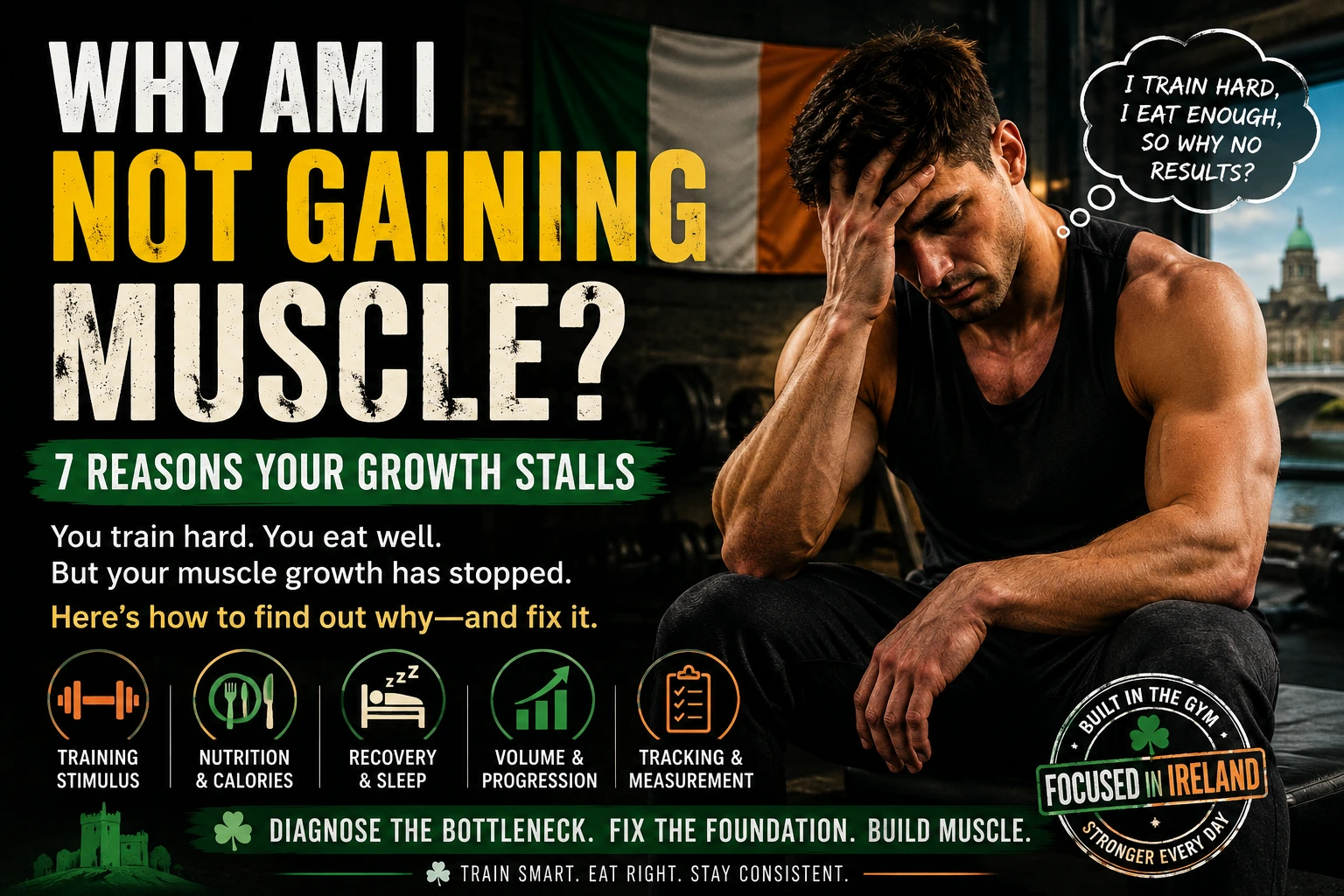
Why Muscle Growth Stalls Even When You Train Hard
You train consistently, push your workouts hard, and may even be adding weight to the bar, yet your physique seems to have stopped changing.
If you are wondering “why am I not gaining muscle?”, the answer is not always that you need to train harder. Muscle growth depends on the interaction between training stimulus, nutrition, recovery and time. When one of those becomes the limiting factor, progress can slow even when effort remains high.
A recent review of muscle-growth plateaus also notes that long-term plateaus are complex and should not automatically be explained as simply reaching a fixed genetic limit.
This guide takes a diagnostic approach: first determine whether growth has genuinely stalled, then identify the most likely bottleneck before changing your programme.
First, Make Sure Your Muscle Growth Has Actually Stalled
Before changing your workout, adding calories or buying another supplement, make sure there is a genuine problem. Muscle growth is gradual, and daily changes in body weight, muscle fullness and workout performance can be misleading.
Your Scale Weight Has Not Changed
If your goal is to gain muscle and your body weight has remained virtually unchanged for a prolonged period, review your energy intake. Look at weekly averages rather than individual weigh-ins because hydration and food volume can move the scale from day to day.
Your Strength Has Stopped Progressing
Strength is not a perfect measure of hypertrophy, but it provides useful information about training adaptation. If performance has stopped improving across several key exercises, review your programme, technique, recovery and nutrition.
Your Measurements Look the Same
Track arm, chest, thigh and waist measurements alongside body weight, progress photographs and selected exercise performance. Several unchanged measures provide stronger evidence of a plateau than appearance alone.
You Are Judging Progress Too Quickly
A few flat workouts or several weeks without obvious visual change do not necessarily mean that your programme has failed. One controlled study found measurable strength and muscle-size improvements after four weeks of resistance training in previously untrained men, illustrating that adaptations can occur early while still varying between individuals.
1. Your Training Stimulus May Not Be Increasing
Training harder does not necessarily mean training better. If the same exercises, loads, repetitions and execution are repeated indefinitely without meaningful progression, the stimulus may no longer be changing enough to support continued adaptation.
Doing the Same Workout for Months
Consistency is valuable, but consistency should not mean performing identical workouts without progression. A training log can reveal whether repetitions, load, sets or execution are gradually improving.
Increasing Weight Without Improving Execution
Adding weight is useful only when the target muscles continue to receive an appropriate stimulus. Heavier loads that shorten range of motion or substantially change technique can make the number on the bar misleading.
Not Training Close Enough to Your Limit
Muscle growth does not require every set to be an all-out effort, but sets that are consistently too easy may provide less stimulus than intended. Aim for challenging, technically sound work that you can recover from.
Changing Programmes Too Frequently
If your programme changes every week, it becomes difficult to determine whether you are progressing. Keeping key movements stable long enough to collect useful performance data can make training easier to evaluate.
2. You May Not Be Eating Enough to Support Growth
Training provides the stimulus, while nutrition supplies energy and raw materials for adaptation. If you are trying to gain muscle while consistently eating around maintenance or below your needs, progress may be slower than expected.
Your Body Weight Is Completely Static
For a deliberate muscle-building phase, a completely static body-weight trend is a useful reason to review calorie intake. It is not an instruction to gain weight rapidly; it is a signal to compare your intake with your actual goal and progress.
You Are Underestimating Your Calorie Intake
Oils, sauces, snacks, drinks and inconsistent portions can make actual intake different from what you estimate. Tracking food for a period can establish whether your diet matches your intended target.
You Are Eating “Clean” but Not Enough
A diet can contain mostly nutritious whole foods and still fail to provide enough energy for a particular muscle-building goal. Food quality matters, but total intake matters too.
Your Protein Intake May Be Inadequate
Protein is particularly relevant because resistance exercise and protein intake both influence muscle protein synthesis. A systematic review and meta-analysis of 49 studies involving 1,863 participants found that protein supplementation augmented gains in fat-free mass and strength during prolonged resistance training. The analysis found no further increase in fat-free-mass gains above a total protein intake of about 1.62 g/kg/day, although the authors noted uncertainty around the precise breakpoint.
This should not be interpreted as a universal rule that everyone must consume exactly 1.6 g/kg/day. Individual requirements vary with body size, training status, energy intake and goals. The practical lesson is to pay attention to total daily protein rather than obsessing over one post-workout feeding.
3. Your Recovery May Be Limiting Your Progress
More training is not automatically better training. Resistance exercise creates a stimulus for adaptation, but your body also needs recovery to respond to it.
Training More Is Not Always Training Better
Adding sets can help when your workload is insufficient, but additional volume can also create fatigue without proportional benefits when recovery is inadequate.
You May Be Accumulating Too Much Fatigue
Training stress can combine with insufficient sleep, calorie restriction and normal life stress. If performance is declining and workouts feel increasingly difficult, the answer may not be another training day.
Sleep Can Affect Training Quality
Poor sleep can make it harder to train consistently and manage fatigue. Before adding another supplement, look at whether your recovery routine is actually supporting your training.
Rest Days Are Part of the Programme
A rest day is not wasted time. The appropriate amount depends on training frequency, volume, intensity, experience and individual recovery capacity.
4. Your Programme May Have Too Much or Too Little Volume
Too Little Work
If a muscle group receives very little challenging work, there may not be enough stimulus to maximize adaptation.
Too Much Work
More sets do not guarantee more growth. Once recovery becomes the limiting factor, additional work can make it harder to maintain high-quality training.
Quality Sets Matter More Than Endless Sets
Instead of chasing an arbitrary number of sets, choose a workload that allows productive training and recovery. Start with a manageable amount, monitor performance, and adjust gradually when the data supports a change.
5. You May Be Getting Stronger Without Seeing Obvious Size Gains
Strength and hypertrophy overlap, but they are not identical. Strength can improve through technique, coordination, neural adaptations, exercise familiarity and increases in muscle size.
Therefore, a stronger bench press or squat does not automatically mean your physique will change dramatically in the same period. Conversely, a slower rate of strength progression does not prove that no hypertrophy is occurring.
Use performance data together with measurements and photographs instead of relying on one metric.
6. Your Exercise Selection May Not Match Your Goal
Are You Actually Training the Muscle You Want to Grow?
Review whether your exercises and execution actually emphasize the muscle groups you want to develop.
Are You Using Exercises You Can Progress Reliably?
An exercise may be excellent in theory but difficult for you to reproduce consistently. Choose movements that allow useful performance comparisons from session to session.
Is Your Technique Consistent Enough to Track Progress?
If repetition quality changes substantially, apparent progress may simply reflect changes in execution. Consistent technique makes your training data more meaningful.
7. Your Expectations May Be Moving Faster Than Your Physiology
Beginner Progress Is Different From Advanced Progress
New lifters can often make relatively rapid improvements. As training experience accumulates, adaptation can become slower. A recent review describes declining rates of adaptation with chronic resistance training while emphasizing that plateau mechanisms are complex.
Visible Muscle Gain Takes Time
Small changes are difficult to see when you look at yourself every day. Consistent photographs, measurements and performance records make gradual progress easier to identify.
Compare Your Current Data, Not Someone Else’s Physique
Lighting, posing, genetics, training history and body composition can make online comparisons misleading. Your most useful comparison is your current data against your own historical data.
The Muscle-Growth Plateau Checklist
| Question | If the answer is “No” |
|---|---|
| Am I progressively challenging my muscles? | Review training progression. |
| Is my calorie intake appropriate for my goal? | Review food intake and body-weight trends. |
| Am I consuming enough protein? | Review daily protein intake. |
| Am I recovering between sessions? | Review sleep, fatigue and training frequency. |
| Am I tracking performance? | Start recording key exercises. |
| Am I measuring physique changes? | Add measurements and consistent photos. |
| Have I given the programme enough time? | Avoid changing everything too quickly. |
What to Change First When Muscle Growth Stalls
Step 1 — Check Your Data
Review body weight, measurements, photographs and training performance.
Step 2 — Check Training Progression
Determine whether your programme provides a progressive and repeatable stimulus.
Step 3 — Check Calories and Protein
Make sure your nutritional intake is compatible with your current goal.
Step 4 — Check Recovery
Look at sleep, rest days, training frequency and overall fatigue.
Step 5 — Make One Change at a Time
Changing your workout, calorie intake, supplements and sleep schedule simultaneously makes it difficult to identify what actually helped.
Step 6 — Reassess After Enough Time
Give the adjustment enough time to produce useful data before making another major change.
Do Supplements Matter When Muscle Growth Stalls?
Supplements can have a role in a muscle-building programme, but they should remain secondary to training, nutrition and recovery.
The large protein meta-analysis is useful here: resistance training itself was a much stronger stimulus for strength development than adding protein supplementation, even though protein supplementation provided additional benefits in the studies reviewed.
Where D-Bal Fits Into a Muscle-Building Routine
For readers who already have their training, nutrition and recovery fundamentals in place and are exploring additional sports-nutrition support, our D-Bal Ireland review provides a detailed look at the product, its current formula, intended use, potential benefits and limitations.
D-Bal should be considered supplementary support rather than a replacement for progressive resistance training, appropriate nutrition and recovery.
When Should You Change Your Programme?
Change It When Data Shows a Problem
If performance, measurements and recovery consistently indicate that your current approach is no longer working, a programme adjustment may be appropriate.
Do Not Change It Just Because Progress Feels Slow
Feeling impatient is not the same as having evidence of a plateau.
Give Adjustments Enough Time to Evaluate
Make changes systematically and record what happens. This turns your training programme into an ongoing experiment rather than a series of random changes.
Frequently Asked Questions About Muscle Growth Plateaus
Why am I not gaining muscle even though I work out regularly?
Possible reasons include insufficient training progression, inadequate calorie or protein intake, excessive fatigue, poor recovery, unsuitable exercise selection or simply not allowing enough time to see measurable changes.
Can you get stronger without gaining much muscle?
Yes. Strength can improve through technique, coordination and neural adaptations as well as increases in muscle size.
How do I know if my muscle growth has actually plateaued?
Look at body-weight trends, measurements, progress photos, training performance and programme consistency together. A short period without visible change is not necessarily a true plateau.
Should I eat more if I am not gaining muscle?
If your goal is muscle gain and your body weight and other progress markers remain stagnant, reviewing calorie intake is reasonable. Avoid making dramatic changes without first looking at your overall data.
Can too much training stop muscle growth?
Excessive training stress can interfere with recovery and performance. More training is not automatically better if you cannot recover from the workload.
How long should I wait before changing my workout programme?
There is no universal number of weeks that applies to everyone. Base the decision on training history, progression, recovery and multiple measures of progress.
Do supplements help if muscle growth has stalled?
Some supplements can provide useful nutritional support, but they should not compensate for inadequate training, nutrition or recovery. Address the fundamentals first.
Final Takeaway: Diagnose the Plateau Before You Fix It
If you are asking “why am I not gaining muscle?”, the first step is not automatically to train harder or buy another supplement.
Start by determining whether your progress has genuinely stalled. Then examine four major areas:
Training stimulus → Nutrition → Recovery → Measurement
If training is not progressing, improve the stimulus. If calorie or protein intake is inadequate, address nutrition. If fatigue is accumulating, improve recovery. If you cannot tell whether you are progressing, improve your tracking.
Only after these fundamentals are in place does it make sense to consider additional supplementary support.
For readers who have already built those foundations and want to explore a dedicated muscle-building supplement, see our D-Bal Ireland review for a detailed evaluation of the product and its current formulation.
The goal is not to do more simply because progress feels slow. The goal is to identify the limiting factor, make a measured adjustment, and give your body enough time to respond.